
Remember our friend the whiny senator? He’s baaaaack. Also, he doesn’t have a name, which is fine, because if he had a name it would not be worthy of a cat.
I am pretty sure Senator-Who-Must-Not-Be-Named is based on a real guy, because Victor Hugo was himself a senator and this chapter feels 100% like it was written so he could skewer his most hated colleague(s). The chapter opens by introducing the senator as a man who “made his way regardless of all those obstacles he would have encountered that we call conscience, solemn oath, justice, duty.”
Get his ass, Victor.
He paints a pretty clear portrait of a self-serving privileged politician, the type who, having no moral convictions of his own, believes other peoples’ acts of goodness are performative at best or signs of weakness at worst. There is no need to wonder how a stand-up guy like him has made it to a position of political power, because he is everywhere.
Almost the entire chapter is a rant the senator gives when he’s at dinner with the bishop, and I have to know what mutual acquaintance thought that was a good idea to set up. Drunk on wine and self-importance, he lectures the bishop about how he doesn’t believe in an afterlife and so, logically, there is no point to being a good person, and the best course of action is to gain as much as you can for yourself in this life. He believes that religion and the promises of a heavenly reward are comforting lies sold to the poor to make it possible for them to endure a shitty existence. (This is 100% a guy who says “Religion is the opiate of the masses” without understanding the larger context of the quote.)
It’s a fascinating chapter, not least because it sounds like the textbook rant of an internet atheist. (Should go without saying that in this case I am referring to a particular type of Annoying Online Edgelord, and not referring to any atheists who happen to use the internet, many of whom are more philosophically thoughtful and morally grounded people than many people who purport to revere Christ.)
The thing is, the senator isn’t totally, completely wrong—some of his arguments are grounded in salient points, though the moral reasoning goes awry.
Somewhat surprisingly, the bishop doesn’t debate the senator (who very clearly has “DEBATE ME BRO” energy radiating from him) or categorically refute his points, even though we know he is totally capable of genteelly tearing him apart à la Isaac Chotiner or the Menswear Guy.
Rather, the bishop responds like he’s patting a very dumb dog on the head and saying, “Good boy!” (I am taking notes.) He claps his hands and congratulates the senator for thinking all this, a philosophy that only works if you happen to be rich, all up on his own (jeez that’s savage right there), and tells him he’s such a “kindly prince” for letting the poor have religion instead of doing anything about the fact that they’re poor.
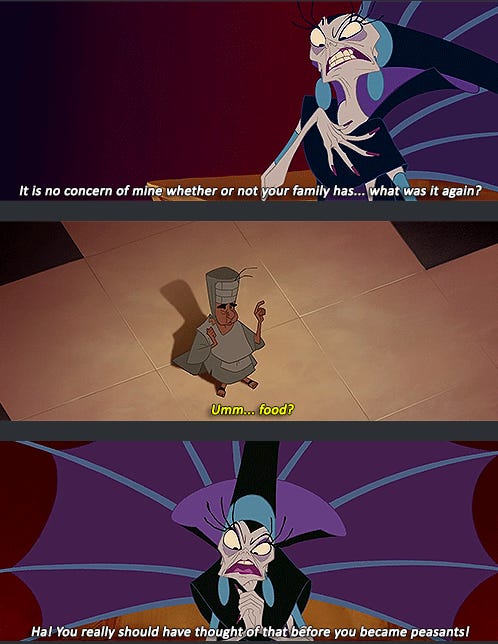
In short, you may be momentarily swayed by the senator’s self-serving edgelord manifesto, but the bishop just smiles and gently points out—in a way the senator himself probably doesn’t understand—that he is just Yzma from The Emperor’s New Groove.
Leave a Reply