Part I, Book 2, Chapter 7
Inside Despair
Like the previous chapter, we’re taking a break from the present-day plot to chew on Valjean backstory, and this feels like moralizing Hugo at his best—it becomes clear with this chapter, I think, that his intention with Les Misérables is to thoroughly teach his readers to have unconditional empathy for all of humanity with all its flaws.
I have given Hugo a lot of crap for being so goddamn verbose, but I’m starting to see why and am coming around to his way of thinking; you can’t learn empathy without thoroughly plumbing other people’s journeys and attempting to understand their inner lives, and you wouldn’t get the same out of this story if it was just a base-level summary of what happened.
Oh god, have I been Hugopilled?
In any case, Hugo delves into Jean Valjean’s character in this chapter, explaining that, while uneducated and ignorant, he is an intelligent man, and spent his time in wretched imprisonment reflecting on the justice of his situation. He recognized that stealing the loaf of bread was morally wrong, but kept arriving at the conclusion that his punishment was disproportionate to the crime (I agree!!).
Hugo deploys, in depicting Valjean’s thought process, a passage structured as a sort of Socratic line of questioning. Valjean, ruminating on crime and punishment, asks himself:
Whether he was the only one at fault in his fateful story. Whether, firstly, it was not a serious matter that, hard-working as he was, he had no work […] he had no bread. […] Whether there had not been greater wrong perpetrated by the law through the penalty inflicted than by the culprit through his offence. […] Whether this penalty, compounded with successive supplementary sentences for the attempted escapes, did not end up becoming some kind of assault of the strong against the weak, a crime of society against the individual, a crime that recommenced every day, a crime that went on for nineteen years.
This is some profound stuff to chew on for most of two decades! The conclusion, when it arrives, feels like the product of a logic proof, making, by Hugo through Valjean, a pretty unimpeachable case against the system.
It also kind of reminds me of the fact that you can be a blackout drunk bro, slurring your words, and still articulate the concept that “following the law […] does not mean it’s right.”
“Having raised an answered these questions,” Hugo writes, “he passed judgement on society, and condemned it.”
I feel like it’s very necessary for Hugo to give us this thought process and its conclusion (here I go, justifying the verbosity!) because there’s a common expectation, I think, that incarcerated people are supposed to 1) somehow “shape up” under excessively cruel punishment and 2) be super grateful upon release and be full of love for society. Here, you can’t imagine that anyone in this carceral system could end up with anything other than extreme hatred for the world that had put them there.
Valjean, Hugo wants us to know, was not born full of anger and hatred, but there was no other possibility for him based on the life he was born to.
This angry face that it calls Justice […] was the only one he had ever seen. The only reason other people had ever laid a finger on him was to hurt him. […] Never, since childhood, […] had he ever encountered a friendly word, a look of kindness. With every succeeding injury, he had gradually come to the firm belief that life is a war […] He had no other weapon than his hatred. He resolved to hone it in prison and take it with him when he left.
[…] Jean Valjean was not a bad person by nature. He was still good when he arrived at the prison.
Hey, I think I found the source material for the line, “And I had come to hate the world / This world that always hated me”!
Hugo, trying to hammer home the state in which Valjean was placed, writes, “Jean Valjean was in darkness. He suffered in darkness. He hated in darkness.”
All I could think of, when I read this, was Bane from The Dark Knight Rises.
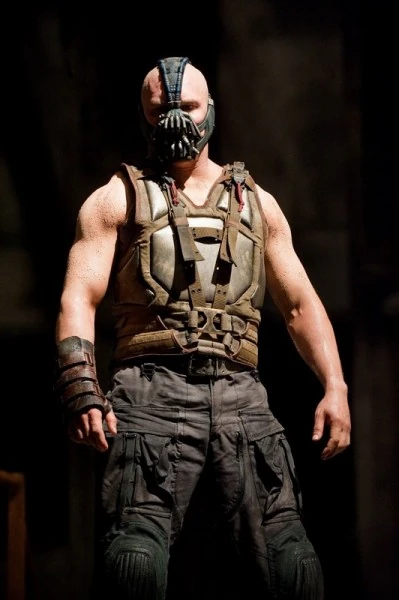
“You merely adopted the dark. I was born in it, molded by it.”
Hugo keeps going. Brutal punishment like that which cast Jean Valjean into character-altering darkness, he says, will “transform a man little by little […] into a wild beast, sometimes a ferocious beast.” Such a transformation affected his ability to reason, hence the escape attempts that drew out his sentence: “He escaped impetuously like the wolf that finds the cage open.”
The description of Valjean, reduced to become less than human to a “wolf,” reminds me again of the way Frances Hodgson Burnett writes that the little beggar girl on the baker’s doorstep in A Little Princess is reduced, by hunger, to a state where she is more wolf than little girl.
Prison makes Valjean capable of both impulsive and premeditated misdeeds (hmm, I wonder if this will explain anything about to happen?), thus being an example of how punishment makes criminals—or, to quote Drew Barrymore quoting Thomas More again, “that you first make thieves and then punish them.”
It is impossible to read all this and not think about the modern carceral system that, in America at least, disproportionately punishes people of color, using them as modern-day slaves while they’re trapped in the system, and then returning them to society more battered, reactive, and vulnerable than before. I wish Les Misérables wasn’t so relevant, but I guess that’s why we still read it.
Before we close out for today, two little details we learn about Valjean, dropped in this chapter:
Valjean learned to read, at age 40, from friars who taught willing inmates, so he at least comes out with some level of literacy. He also possesses inhuman levels of strength—at times doing the work of four men, and many times is used in place of equipment—and is incredibly lithe, so he’s basically able to parkour all around the place.
Drop the workout regimen, Valjean!
Leave a Reply