
Part I, Book 5, Chapter 13
Resolving Some Questions of Municipal Policing
Buckle up because I loved this chapter, much in the same way that I loved Chapter 13 of Book 2 (the one where Valjean robs a child). It will not surprise you at all that there are so many Fantine/Valjean parallels here.
This chapter picks up immediately where the previous one left off, in which Javert has appeared and whisked Fantine away. He takes her to the police station and promptly sentences her to six months in prison.
Six months!!! For punching a guy who might as well have “I deserved that” tattooed on his forehead!!! Javert, you are on something—but then again, this is the same world where Jean Valjean was sentenced to five years of hard labor for stealing a single loaf of bread he didn’t even get to eat, so disproportionately brutal punishment seems to be the law of the land here.
Fantine, who thinks not about how much prison sucks but about how her daughter will surely die if she’s not able to send money for her care, drops to her knees and crawls to Javert, begging him for mercy. It is utterly pathetic in the sense of literal pathos, and the image of a Fantine with a shorn head and missing teeth, on her knees in a ragged dress, is a brutal contrast to the Fantine we saw in Book 3.
On her knees on the disgusting muddy floor, Fantine sobs and unloads her story in a near-incoherent muddle, begging Javert to have mercy and understand. She is so transformed by her grief and desperation that she becomes “beautiful again,” Hugo says. “She would have softened a heart of granite”—(“My heart is stone and still it trembles!”)—”but the heart of a man without feeling cannot be softened.”
Javert coldly repeats that she’s been sentenced to six months, and to get a move on. This man might be a sociopath.
As it so happens, a little while ago, a man had quietly slipped into the room and listened to Fantine’s story. We are not told who this man is, but come on. It’s so funny and borderline exasperating how Hugo keeps doing this thing where he’s like “a man I shall not name arrived!” and we’re like, ok buddy, we all know it’s Jean Valjean, you really don’t have to keep doing this.

The man, who of course is Valjean-as-Mayor-Madeleine, stops the soldiers in the room from dragging Fantine away, thus depriving Javert of whatever sick pleasure he gets out of such things. Javert becomes totally awkward and goes, uh, mister mayor? which Fantine hears.
She realizes that the random dude in the room is the mayor she has come to hate as the cause of all her trouble (man, that lady supervisor has a lot to answer for), so she stands up, says, “Ah! so you’re monsieur le maire!” and spits in Madeleine’s face.
Madeleine very calmly wipes his face and says, “Inspector Javert, set this woman free.”
The whiplash of seeing this breaks Javert’s brain. “[T]houghts and words failed him equally. His capacity for astonishment was exceeded.”
It also breaks Fantine’s brain—she starts wondering aloud about the words she’s just heard ordering her to be let go, and because she cannot comprehend that the “monster of a mayor” who she’d understood to have fired and damned her would be the one to show her such mercy, she talks herself all the way around into the belief that it’s Javert who has been kind and set her free. She says all of this out loud, and rambles for a while about the injustices of her life in the uncomfortable way you might recognize if you ever stop and have extended conversations with people who have been unhoused for a while. In case you were wondering, this poor girl is not okay.
At one point she mentions her debts, so Madeleine, who at this point has a pavlovian response to people in need, immediately takes out his coin purse and asks her how much she owes, to which she whirls on him and says, “I wasn’t speaking to you!”
Omg. This is so funny even as it’s so painful. It is the exact kind of tragic-yet-funny as Roman Roy at the funeral on Succession.
Fantine finally finishes rambling (at one point she puts Javert’s hand on her chest and smiles at him—this girl is so not okay) and then just calmly gets up to leave with a “friendly nod” to the guards like she didn’t just get sentenced to six months in jail and then go on several unhinged rants in front of the police inspector and the mayor. This entire time Javert, brain still broken, has been completely still, “like some statue left in the way, waiting to be put somewhere.”
Hahahaha omg I am wheezing at how funny this is. Those are Hugo’s actual words!
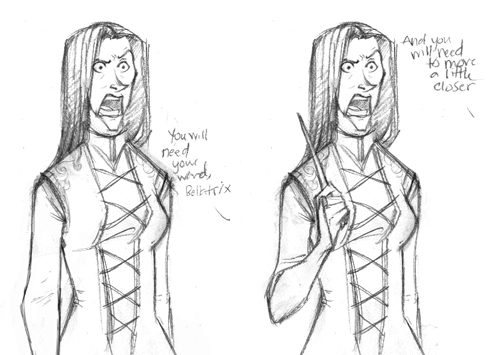
Also, once again I have to use this image:
It isn’t until Fantine is almost out the door that Javert wakes tf up and asks who said Fantine could go. Javert, buddy, you’ve been here this entire time! Do your ears not work?
Madeleine says, “I did,” which now causes Fantine to freeze. Javert, who only just got himself together half a second ago, is so confused he short-circuits again immediately. This chapter has the tension and drama of a tightly plotted scene in a stage play but I love how it’s also “The One Where Mayor Madeleine Breaks Everyone’s Brains Multiple Times.” It’s both very funny and a wonderful callback to when Bishop Myriel did the exact same thing to him! The parallels keep paralleling!
Finally Javert turns his brain off and turns it back on again and reasserts his authority, challenging Madeleine’s ruling. Madeleine calmly explains that he stuck around after the fight to ask the bystanders what happened, and confirmed Fantine’s story and that Bammy was at fault. Hmm, so in other words, he did actual police work while Javert was running around being high on his own power!
Javert’s counter-argument is horribly revealing: the man Fantine attacked “is the enfranchised owner of that handsome three-storey freestone house with a balcony […] [T]his is a matter of policing the streets, which is my concern, and I am detaining this woman Fantine.”
WOW. Javert actually doesn’t care who actually started it: in his worldview, Bammy can’t possibly be at fault because he’s a landowning male (thus higher up in society), and Fantine is guilty purely on the basis of disrupting order on the street. This is straight-up ICE logic.
Madeleine’s response is absolutely legendary. He cites articles of the criminal code by number and date at Javert, and asserts that in matters of municipal policing he outranks Javert and thus can override any of his rulings. INCREDIBLE STUFF. Javert’s ass just got lawyered. What were they teaching in prison school?? Also, is there anything Jean Valjean can’t do???
Javert, who knows he is not going to win this one, finally leaves, and Fantine is “thrown into a strange confusion.” Excellent, since Fantine is to Madeleine as Valjean is to the bishop, that means she is right on schedule to have her own Petit-Gervais existential crisis!
“One of these men was dragging her towards darkness, the other leading her back to the light. In this conflict, seen magnified by terror, these two men appeared to her as two giants. One spoke to her like her demon, the other like her good angel,” Hugo writes, and WOW the parallel to Valjean seeing the figures in his mind’s eye of himself-as-demon, bishop-as-angel is so obvious that I almost want to smack Hugo for being too patronizing to his reader here.
“She trembled. She […] felt the dissolution and dispersal inside her of the frightful shades of hatred, and the birth in her heart of something beyond expression, an indefinable warmth that was joy, trust, love.” AHHH just as Valjean chose The Way of the Bishop and found his hate transformed, so too does Fantine! Bishopness is contagious! Can Hugo be any more obvious about his repeated themes???
Madeleine, fighting his own emotion, addresses Fantine with the formal “vous” (shades of how the bishop addressed Valjean as “Monsieur”!) and tells her that he had no idea she’d been fired and left his factory, asks why she didn’t come to him for help (THANK YOU), and says he will pay all her debts, send for her child, and provide for them both so she never has to work again if she doesn’t want to. This man is so good, I can’t stand it.
“[I]f everything is as you say,” he adds, “and I don’t doubt it, you’ve never ceased to be virtuous and holy in the sight of God.”
AHHH. This is such a beautiful illustration of Valjean’s morality—his belief that desperate circumstances do not make their victims inherently wicked—and is something he understands better than anyone and has painstakingly worked through. It is also—and I wasn’t kidding about this chapter being chock-full of parallels—a mirror reflection of how the bishop told a shamed Valjean that he was good and that his soul had been absolved.
Valjean has clearly thought about that great, beautiful act of the bishop’s, and come to understand its significance, and it’s so lovely to see him doing the same thing for Fantine. He knows what it is to be one of the dregs of society, to have become a “bad person” (for Valjean, a criminal; for Fantine, a whore) and to internalize that definition of yourself; he knows it is not enough to get someone out of a scrape, that a life can be changed if that person is brought to the light and made to understand that they are still good. I keep using the word “beautiful,” I know, but this is such a beautiful lesson—for Fantine, for Valjean (who now has been on both sides of this exchange, love that for him), for all of us.
It is possibly too much for Fantine. Valjean may have been “about to faint” when the bishop absolved him, but Fantine is already not doing so great (ominous cough, remember?) and actually faints.
And thus the chapter, and Book 5, ends.
Leave a Reply