Part I, Book 7, Chapter 3
A Storm in the Mind
We begin this chapter with the amazing sentence “The reader has no doubt guessed that Monsieur Madeleine is none other than Jean Valjean.”
NO, REALLY???
Hugo, you are killing me here. Once again,
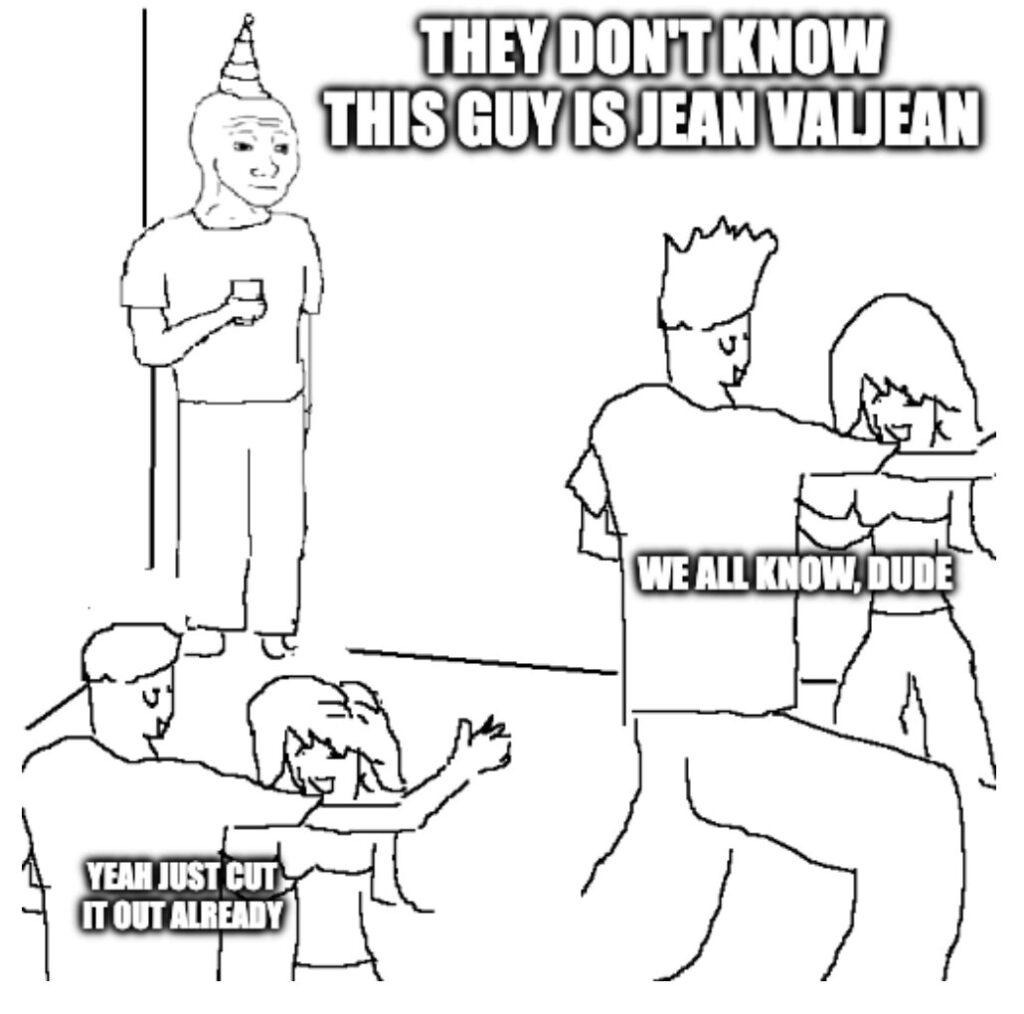
I have questions about this opening sentence. Was Hugo concerned for any potential readers with poor reading comprehension? Was this sentence meant to be funny? I am now imagining the poor dense reader for whom the Madeleine/Valjean reveal is shocking news.
Anyway. The last time we “gazed into the depths of that conscience,” it was the last chapter of Book 2 and Madeleine was Jean Valjean. “The moment has come to take another look.” Oh goody! I love this thing we’re doing where we keep checking in on this poor guy in the moments of his greatest turmoil.
This is one of the longest chapters, if not the longest (I’m not keeping close track) in the book so far. Hugo insists, though, on still catching the reader up on Jean Valjean’s life after the Petit-Gervais incident, as if we hadn’t already gathered from reading all of Books 5 and 6. Valjean sold the bishop’s silver but kept the candlesticks (we know), disrupted the black jewelry industry (we know that too), became mayor (we KNOW), hid his past and devoted himself to God by way of helping others (WE! KNOW!). If you are a reader of this novel who happened to suffer amnesia in between books, good news, Hugo has got your back.
The majority of this hefty chapter describes the raging tumult in Madeleine/Valjean’s head over his moral dilemma of whether or not to turn himself in and save his doppelgänger Champmathieu. It’s kind of a philosophy professor’s wet dream. Here is a non-exhaustive summary of the inner conflict our poor protagonist goes through (with my commentary, of course):
- His need to hide his true identity and his sense of duty to others are usually two compatible goals; here for the first time they’re directly at odds with each other.
- When Madeleine hired the horse and tilbury, he actually had no idea whether or not he was going to go through with his plan of traveling to Arras the next day. A contingency planning king.
- He is—and this is weirdly beautiful—amazed that his Madeleine-self is still intact after his Valjean-self was awakened by Javert’s report, and marvels that his soul contains both. I really, really love this split-identity depiction of the fractured, opposing selves; it’s very Jekyll/Hyde, very Florestan/Eusebius.
- He ponders the possibility that his inevitable fate—of being discovered and dragged back to the prison hulks—could be cut off, and that he has been saved from said fate. It’s not his fault Champmathieu is in this position, he reasons; in fact, all this could actually be God’s will, for the sake of the Madeleine-self persisting and doing good.
- There’s a fascinating thematic loop here; Jean Valjean himself is somewhat obviously a Christ figure in the narrative, but in this inner monologue he contemplates the meaning of another person sacrificing themself for his sins.
- I am not pulling the Christ comp out of nowhere; Hugo includes the line “another condemned man two thousand years earlier” in describing the kind of motivation Valjean is feeling, and at the end of the chapter compares Valjean’s internal struggle to “the mysterious being in whom are concentrated all the saintliness and all the sufferings of humanity had also refused for a long time the terrible chalice.” Unless I’m misreading and this is a reference to Indiana Jones, we’re talking about none other than Jesus Christ, and the parallels are intentional.
- Valjean, tormented, sees the dead bishop (😭) watching him and seeing him for who he truly is; he feels that his bishop-induced goal of being a good and righteous man will be destroyed if, by robbing another man of his freedom, he will essentially have returned to a life of thievery.
- At this point, he decides he must save Champmathieu, and in preparation promptly burns all the notes recording debts that people owe him—I love this man so much. I love that his first priority, upon deciding his life as he knows it is over, is to clear other people’s debts.
- At this point, he decides he must save Champmathieu, and in preparation promptly burns all the notes recording debts that people owe him—I love this man so much. I love that his first priority, upon deciding his life as he knows it is over, is to clear other people’s debts.
- Madeleine/Valjean then remembers: FANTINE. If he gives himself up, then Cosette is doomed, as are all the workers and townspeople dependent on him. (“If I abandon them, how will they live, if I am not free?”) Fantine will have died in vain, he will have failed in his promise to save her child, and the people he has lifted out of poverty will be crushed again. This is an incredible example of the trolley problem.
- He ruminates on the fact that Champmathieu is a thief (shades of the modern-day “he was no angel” that gets trotted out to justify murders by police) and that when you really think about it that way, it’s totally absurd to save one criminal and sacrifice the wellbeing of a community of innocent people.
- I love this—it’s abhorrent thinking and yet perfectly solid trolley problem reasoning?? The moral complexity here is so, so good!
- At this point Madeleine decides to stay and leave Champmathieu to his fate, so he pulls his old Valjean-self belongings out and burns them in the fireplace to destroy the evidence of his old life; after everything burns, all that’s left is Petit-Gervais’ 40-sou coin in the ashes.
- He goes to burn the silver candlesticks–at this point I was like NO DON’T YOU DARE—then he hears a voice in his head reprimanding him for sentencing another soul to bear his name and drag his chain in prison (the way this is put is so good), and realizes that all the blessings of his name are for naught if there is this one wretched soul cursing him, because GOD KNOWS.
- He then wrestles with the actuality of what his choice would look like: he pictures leaving all the beauty, sweetness, and goodness of his new life behind (birdsong! long walks! giving coins to little children and making them happy!) and spending the rest of his life in abject misery, doing backbreaking menial labor in prison for the rest of his days. This mental picture is actually incredibly gutting and turns all of this abstract moral pondering into something real and immediate.
- “And whatever he did, he kept coming back to this agonizing dilemma that underlay his reflections: Remain in paradise and become a demon! Return to hell and become an angel! What should he do? God Almighty! What should he do?”
- This is so, so, SO much better than the “Who Am I” song, like omg.
The chapter, and Madeleine/Valjean’s agonizing, ends with no final decision on what the right thing to do is, but with the sense that either way, “some part of him was bound to die, and there was no possibility of avoiding this. That either way he was entering a tomb. That he was in the throes of death, the death of his happiness or the death of his virtue.”
I know I keep saying “this is so good,” but lord this is all so, so good. Poor Madeleine/Valjean is really trapped in the mother of all trolley problems, and his agonizing is so compelling and so real. It’s all so exquisitely painful and as the reader I honestly can’t say what the “right” course of action is, because right and wrong here is so muddled!
We know what he’s going to do, but it doesn’t make the journey there any more clear.
Leave a Reply