Part I, Book 8, Chapter 3
Javert Satisfied
Javert has arrived on the doorstep of the room in which Madeleine is by a somewhat delusional and dying Fantine’s bedside. If I were writing this chapter, it would go something like this:
Madeleine: Javert! What are you doing here?
Javert: I heard about the trial where you outed yourself as Jean Valjean, I thought about it, and you know what? I realized my understanding of people was all wrong and that not only can people change and become better, but we really all should endeavor to be kind and good. You’re a fundamentally good person, no matter what you did in the past, and I have used my authority to clear Jean Valjean’s entire criminal record.
Madeleine: Wow, that’s really nice of you, Javert, but I’ve still got a suffering mother dying here—
Doctor: [bursts into room] Hey everyone, I didn’t want to mention this before in case it didn’t work, but last night I invented penicillin or whatever it is that’s scientifically necessary to cure whatever the heck Fantine’s sick with, and I gave it to her, and if my calculations are correct she should be completely healed right about now!
Fantine: [stops coughing] Wow, I’m totally fine now, and I feel great! Other than the fact that my child isn’t by my side!
Javert: Funny you mention that, I went to this shady inn in Paris where the innkeepers were definitely abusing this little girl who said her name was Cosette. I remembered that was your kid’s name from that incoherent rant you gave, so I scooped her up and put the Thénardiers in jail.
Madeleine: Wait, I thought you decided people can change and become better?
Javert: Yeah, but not these people, they sucked. Trust me.
Fantine: Wait, so where’s Cosette?
Cosette: [appearing from behind Javert] Hi maman, it’s me! I was treated pretty badly by those terrible innkeepers but for wish-fulfillment reasons I’m not experiencing any psychological or developmental harm from the abuse. I love you!
Fantine and Cosette: [have a beautiful and heartfelt reunion despite Cosette not having seen her mom for 70% of her life]
Javert: Oh, and on the way here I saw Bamatabois and Tholomyès walking along a cliff, so I pushed them off. They’re totally dead. Through the vague power of the law that no one needs to understand I took their money and decided to give it to you, Fantine. You’re hella rich now!
Madeleine: Once again, I have to ask why you decided to push two guys off a cliff when I thought you were all about goodness now.
Javert: Trust me, these guys were massive assholes and everyone’s going to be happy they’re dead now.
Madeleine: I’m not going to think about it too hard. This is all pretty great! I’m going to go read some books and listen to birdsong now!
Fantine: I’m going to go live in a big house with a garden with my little girl and never get involved with shitty men ever again!
Javert: And I’m going to go do something worthwhile with my one wild and precious life!
END
And this is why I’m not a novelist.
Here’s what actually happened in this chapter:
As we can infer, Madeleine left the town of Arras immediately after his biblical exit from court, returned to Montreuil-sur-mer (around 6 AM—onthe heels of an already sucky and long travel day, remember), and went straight to the hospital to see Fantine.
In the meantime, the court cleared Champmathieu, but the public prosecutor (another guy I would like to push off a cliff) “had to have a Jean Valjean” (why?? is the guy being paid commission based on how many poor dudes he locks up?) and conferred with the judge. The judge, who I would like to remind you was up until now a Mayor Madeleine superfan, agreed and issued an arrest warrant for Madeleine.
Said arrest warrant was immediately sped to Javert via special messenger, and Javert discovered not only that he gets to arrest the object of his one-man hater’s club, but also that his insane conspiracy theory about Madeleine being escaped convict Jean Valjean WAS TOTALLY RIGHT. It is never a good sign when a fascist sociopath feels this validated. He found out where Madeleine was and made a beeline to Fantine’s room at the hospital, which is how the previous chapter ended the way it did.
The sight of Javert in his triumphant glory is a terrible sight to behold. “It was the face of a demon on retrieving one of his damned.” A frightening sentence, but also a total BAR. Hugo, you must have been proud of that one.
We get several paragraphs about how Javert, high on his righteous victory over the mayor he secretly hated, is ablaze with whatever the opposite of divine light is. It is not the light of God, but the fire of the law.
Picturing Javert in this moment, I immediately thought of the image of Judge Frollo from the Disney version of The Hunchback of Notre Dame in “Hellfire”:
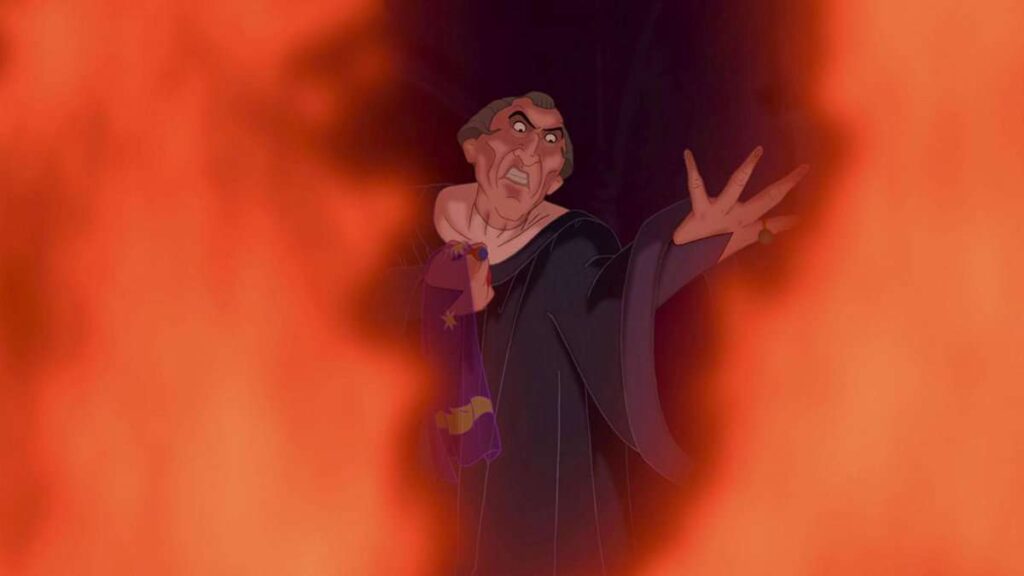
(Aside: it took way too long for me to make the connection that Disney’s Hunchback is based on, of course, ANOTHER VICTOR HUGO NOVEL, and I am not very smart for seeing the Javert-Frollo parallel because it is in fact the most obvious thing in the world. Can you believe I am a public intellectual.)
I really love the realization Hugo leaves us with at the end of this chapter: that the law in all its righteousness is not necessarily aligned with what is right. It is not that Javert is evil; he is doing exactly what, in his worldview, is morally correct, and he has the entire justice system backing him up. But we as the reader also fully understand that there is something twisted about all of this. It’s a repetition of an idea Hugo has already harped on: that the legally “correct” things society does to individuals are, themselves, a kind of crime.
If it wasn’t already obvious, Hugo wants us to know that Javert isn’t the hero here, and says as much. “Unaware of it himself, Javert in his fearsome gladness, like every benighted individual who triumphs, was to be pitied. There was nothing so poignant and terrible as this face, displaying what might be called all the evil of goodness.”
ALL THE EVIL OF GOODNESS. I know I’m so tragically Hugopilled already, but I continue to marvel at how freaking relevant these themes are to the modern era.
And we would never have landed on this painful and insightful truth about human nature and society if we’d gone with my alternate version of the story. I hate to admit it but Hugo knows what he’s doing.
Leave a Reply