Part II, Book 3, Chapter 2
Two Finished Portraits
Here we find pretty much all the source material for “Master of the House.” I’d always assumed that the song was just character-painting vibes—here are two terrible people and the things they do and believe—and turns out pretty much every word comes straight from Hugo.
As an example, Madame Thénardier’s line about her husband, “Cunning little brain, regular Voltaire,” sounds like it was written to fill beats and set up the coming punchline, but it turns out that Thénardier is literally described as “cunning” (and “slippery,” and “crafty”) and is actually described as a guy who frequently quotes Voltaire in conversation. No confirmation, though, on whether or not “There’s not much there.”
And indeed, the man is solicitous to everyone and strives to create the impression that he is a witty “man of learning,” so his characterization in the musical is actually spot-on.
There is a note that the Thénardiers don’t keep servants anymore (no servants when you run an inn in 1823!!!) because Monsieur Thénardier kept sleeping with them, and Madame Thénardier is the jealous type. First of all, I am so psychologically repelled by the image of this smock-wearing “pale, […] puny man” getting it on. Yuck.
Second of all, I am going to get all Tumblr for a moment here. When I saw the current West End production of Les Mis in London in winter 2025, I noticed they’d updated a couple minor lines here and there in the musical. One of Thénardier’s lines in “Beggar at the Feast,” which in the original English version goes, “This one’s a queer, but what can you do” got changed to “This one’s a queer, and I’ve tried that too,” taking it from casually homophobic to…Master Thénardier, evil bisexual icon?
I figured that they changed the line because no one needed the random drive-by homophobia (and there is already so much about Thénardier that’s awful, we don’t need the extra sprinkle) and it also made the line kind of funny (in the show Madame Thénardier’s reaction to this line got some hearty laughs). But in this chapter, Hugo mentions that Thénardier messed around with the servants…and doesn’t say that the servants had all been women.
Yes, presumably the help would have been female by default because Western European society in the 1800s blah blah blah. But Hugo doesn’t confirm that they had all been female. So if you really wanted to, one could argue that there is oblique proof that Thénardier got freaky with men and is canonically bisexual. The updated line actually holds up under this argument.
I realize that was all extremely Tumblr logic. I did warn you.
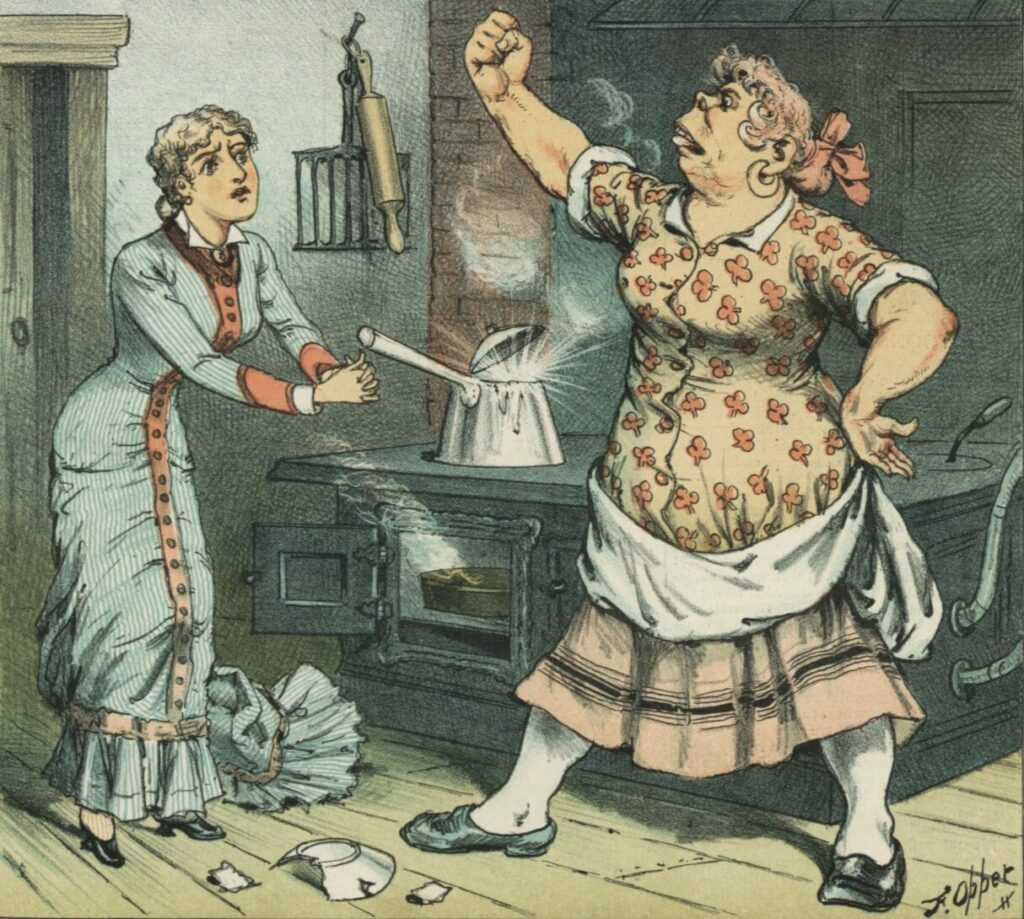
Now, onto Madame Thénardier. She’s described as a “giantess,” a huge decidedly unfeminine hulk of a creature—there aren’t whiffs of physiognomy so much as there are pressure waves. Reading Hugo’s description reminded me of this anti-Irish cartoon (which I wrote about last year):
Because of Madame’s fearsome appearance, people take one look at her and assume she runs the show. “[E]very newcomer to the inn would say, ‘That’s the master of the household.’” ([Ron Howard voice] Hey, that’s the name of the song!) “Wrong. She was not even the mistress. It was the husband who was both master and mistress.”
Just gotta say, describing Thénardier as “both master and mistress” is not helping him beat the bisexual allegations.
It’s noted that Madame “loved only her children and feared only her husband” and by “her children” Hugo really just means her daughters, Éponine and Azelma, because she doesn’t give a crap about her son.
And how is the Thénardiers’ money situation? Turns out, it’s not great! Thénardier used his corpse-robbing haul to open the inn in Montfermeil, and said haul “had not carried this […] innkeeper very far.” He chose pretty poorly by setting down roots in this village without water—”In Switzerland or the Pyrenees this have-not would have become a millionaire.”
His money troubles are so bad, in fact, that at this point in the story he’s 1500 francs in debt. That’s a lot of money!! What did you do, Thénardier, max out all your credit cards?? This puts Fantine’s debts to shame, and that poor girl could not manage her money for the life of her if you set her loose in r/PersonalFinance.
Thénardier’s great talent, it seems, lies in his instinctive understanding of the value of hospitality to people—not in an Unreasonable Hospitality way, but in a grifter way. He has a gift for seeing every opportunity possible to fleece travelers. I was pretty floored when I hit the part of this chapter that is essentially him monologuing about all the ways you can nickel and dime your guests: “to charge for the open window, the closed window,” and “to know how much the mirror is worn out by being obscured and set a price on it,” for example. This is where “three percent for sleeping with the window shut” and “two percent for looking in the mirror twice” comes from!!! The lyrics are straight out of the source text!
Poor, poor Cosette; this is an awful place to spend your childhood. “Cosette was trapped between them, enduring their twofold assault on her […] Cosette was beaten black and blue—this was the woman’s doing. She went barefoot in winter—this was the man’s.”
Fantine, you sweet clueless idiot, this is what you unwittingly gave your child who you loved so much. This is why you vet your childcare!!! These Thénardiers are so horrifically awful, I want to push them both into the nearest death trench.
Leave a Reply