
Part II, Book 3, Chapter 8
The Vexation of Playing Host to a Poor Man Who May Be Rich
Excellent chapter. It’s character-driven, with every beat revealing so much about the character and motivations of everyone involved. The thing is, it’s a really hard chapter for me to succinctly summarize because while the chapter is long, every line provides detail that feels crucial to understanding the characters and their relationships to each other. There are times Hugo could use an editor or two, but other times his storytelling is just so tight.
It also feels like a quintessential Hugo chapter in that what transpires is both sitcom levels of funny and painfully heartbreaking, all at the same time. And the entire chapter is like a microcosm of how money effects different societal dynamics, with the Thénardiers—abhorrent victims that they are—standing in for a large swath of society.
In short, I loved this chapter!
So Cosette and Jean Valjean (once again he has yet to be named within this book, but we know who he is) arrive at the Thénardiers’ inn, and Cosette receives her usual welcome (not great) from Madame Thénardier, whose demeanor changes when Cosette announces that she’s brought a prospective guest.
Madame is solicitous of her new mark for all of two seconds before Valjean—gasp—treats her with politeness, immediately tipping her off that he’s poor. This conclusion is backed up by his worn clothing. How screwed up is the world we live in where treating service workers with respect is proof that you’re lower-class?? Madame becomes very curt and addresses Valjean as “old man.” Rude.
Hubby Thénardier sizes the guest up, comes to the same “I don’t eff with poorsies” conclusion, and tells Valjean that there’s no room at the inn. Valjean says he’s happy to be put in the attic or the stable, and he’ll pay the price of a room—oh my god, I’m getting flashbacks to Part I, Book 2. Thénardier realizes the guy is desperate, and promptly charges him twice the actual rate—good lord, the poor people tax was a thing even then.
Cosette returns to her usual place—which is under the table—when Madame asks where the bread is. Cosette realizes that she completely forgot to complete her second Old Enough! challenge and does the only thing she’s learned to defend herself: lie and claim the bakery was closed.
Madame asks for her 15-sou coin back, and poor Cosette turns out her pocket to find it empty. Instead of making the reasonable conclusion that a malnourished and barefoot 8-year-old hauling something her own weight for miles is likely to lose something out of her pocket, Madame decides that Cosette is a little thief and grabs a strap to start beating Cosette. Mind you, this is all happening in the dining room where all the guests are, and all of them are unfazed because apparently whipping a small slave child is perfectly normal dining room behavior. Jesus everloving Christ.
Jean Valjean, thankfully, intervenes—clocking that Cosette unintentionally lost a coin given to her, he interrupts and says he saw something roll out of her pocket, and pretends to search on the floor for it. He “finds” a 20-sou coin and hands it to Madame, who accepts. I am overcome by the grace of this man, who summed up the situation and found a way to provide cover for poor little Cosette. It’s also fascinating that while Madame—who knows the difference between a 15-sou and 20-sou coin—is fully aware that the “oh look, I found the coin” charade is a lie, she doesn’t care because she’s profited from the situation. I feel like that right there is the attitude of a grifter, encapsulated.
Eponine and Azelma come dancing into the dining room, looking healthy and pampered—it’s a stark contrast to Cosette, who is so ragged, malnourished, and fearful that Hugo says she is straight up “ugly” and appears “to be turning into an idiot or a demon.” The two girls ignore Cosette—such a turnaround from the scene that so charmed Fantine, when all three girls first met—and play with their doll.
Doll-less Cosette enviously watches the girls—for all intents and purposes, her stepsisters—and when Madame sees Cosette shirking her work she grabs the strap again and goes to beat her. Again, in full view of the guests!
Jean Valjean proceeds to go full Mayor Madeleine on the Thénardiers’ asses—some other super-strong hero would give them a beatdown, but this is the kill-’em-with-kindness, throw-money-at-the-problem reverse burglar: he buys the WIP stockings Cosette is supposed to be knitting for her erstwhile-stepsisters for a ridiculous sum (5 francs!!! 4.5% of what he was paid for 19 years of prison labor!) and then tells Cosette that since her work now belongs to him, he orders her to play.
This man is STUNTING. Everyone, including the other guests, is absolutely gobsmacked, and Thénardier privately wonders if this man is an eccentric millionaire.
Madame Thénardier, seeing all this, goes up to Valjean all syrupy-sweet and proceeds to explain to him…why Cosette sucks. I don’t understand this move but I guess that’s why I’m not a grifting innkeeper’s wife! In full earshot of Cosette, Madame Thénardier says Cosette’s mom is a bum who abandoned her kid and is probably dead.
This is the only information Cosette has ever gotten about her mother, which is so depressing I don’t even know what to say. Cosette immediately absorbs this information and starts to rock her sad little lead sword in her arms, saying, “My mother’s dead! My mother’s dead!” This is so unbelievably heartbreaking, and is more or less an identical scene to the parallel moment in A Little Princess when Sara Crewe, also informed by a cruel woman that her only parent is no more, says, “My papa is dead! My papa is dead!”
At this point, Cosette—who so far this evening has endured heavy labor, two near-beatings, and a traumatic info-dump—sees Eponine and Azelma’s abandoned doll (they very relatably moved on to playing with the cat) and instinctively picks it up. She gets a few blissful (and probably therapeutic) minutes holding the doll before Madame notices (Eponine snitches—not a great look, ‘Ponine!) and starts screaming at a sobbing Cosette.
You know, as you do. I cannot believe Fantine did not clock this woman’s rancid vibes.
At this point, Valjean abruptly gets up and walks out of the inn. For some reason this is very funny to me, probably because I imagine him doing it with this energy:
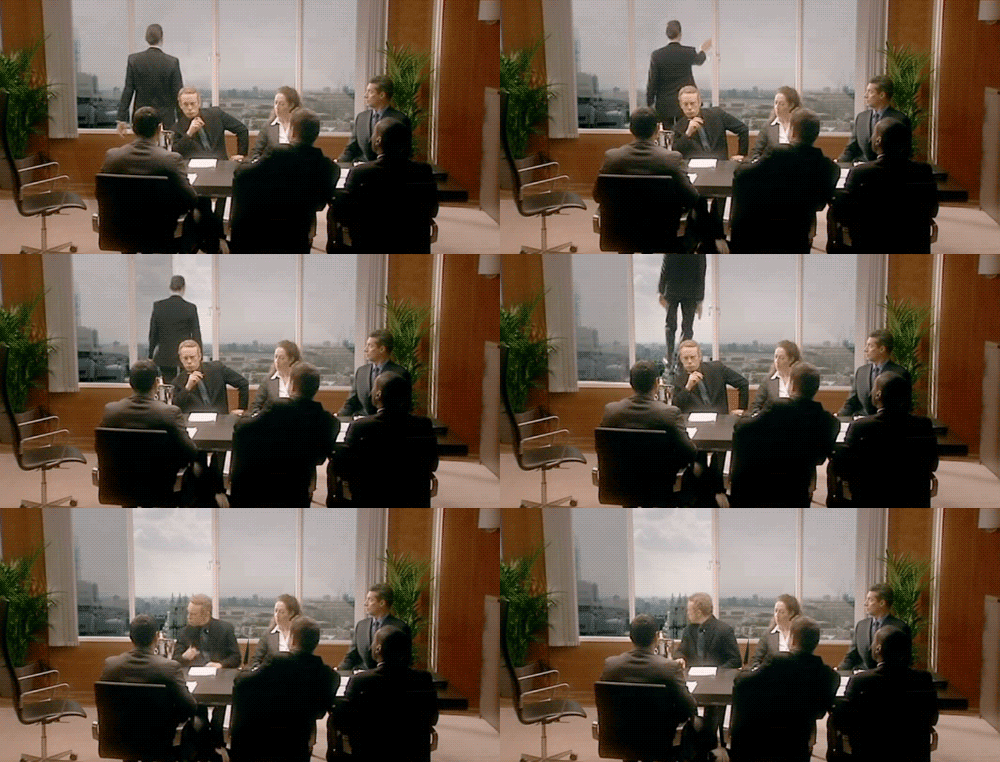
Because if I saw everything that went down this evening in this inn, I too would gtfo.
He returns, moments later, holding THE DOLL from the fancy stand outside, goes straight to the still-crying Cosette, and hands the doll to her. I am dying at how iconic this is. Everyone in the inn is stunned. I imagine that Madame Thénardier’s face looks like this:
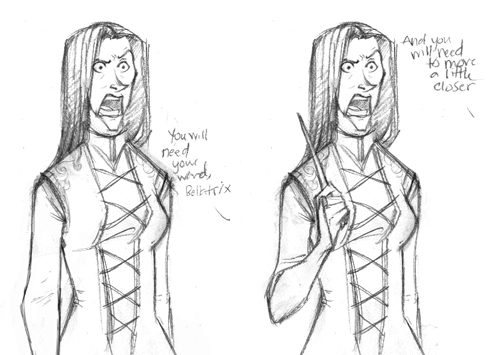
(I cannot believe how evergreen this illustration is.)
I love this moment so much, not only because it is so exceptionally kind, but also because it is trolling at the highest level. Every time the Thénardiers abuse Cosette in front of Valjean, he throws money at them! And they don’t get the idea, so he just keeps escalating until they break! Amazing stuff.
At this point, Thénardier orders his wife to grovel, as the gentleman in their midst is clearly dripping with money and can just casually drop 30+ francs on a doll. I am imagining Madame suddenly turning into one of the brothers in Joseph and the Amazing Technicolor Dreamcoat. Grovel, GROVEL!
Madame—who you can tell hates every bit of this—lets Cosette accept the doll and play with it. Cosette names the doll (“Catherine”—lord, this child has no imagination), puts it on a chair, and sits motionless in front of it.
Valjean urges Cosette to go ahead and freaking play with the doll. Cosette says, in all earnestness, “Oh, I’m playing!”
My god this child is so broken. To her, “playing” with a doll means sitting motionless in front of it. Do you see what I mean by this being funny and heartbreaking at the same time? Her “playing” is like young George-Michael Bluth hanging motionless from the monkey bars.
Eventually everyone in the inn goes to bed, with Valjean staying at the table doing absolutely nothing. The Thénardiers try to be good hosts by not turning in before their last guest goes to sleep, but Madame gives up and goes to bed at 2 AM. Thénardier hangs around, wondering wtf this guy is doing, and finally speaks up at 3 AM.
Honestly, this is just additional master trolling by Valjean, who reminds Thénardier that he needs a place to sleep, and asks which way the stable is. Thénardier instead takes him to the “bridal chamber,” which is the most expensive VIP room in the inn. (I love—LOVE the way this funhouse-mirror-reflects the bishop’s treatment of Valjean when he sought a place to sleep in Part I: the bishop offered Valjean a humble room out of love and kindness, while Thénardier gives him a luxurious abode out of a desire to exploit the absolute shit out of him.)
Also, “bridal chamber”? Imagine having your wedding night in this place. Ugh, bleak.
Thénardier goes to bed, and Valjean pops right out of his room and explores the inn. (Does this man…not need to sleep?) He finds Cosette curled up fully clothed on a nest on the floor under the stairs. Like mother, like daughter! (Is that mean?)
HANG ON. Cosette is an scrawny unwanted, unloved ward who is mistreated and put to work in a cruel household, who wears castoffs and sleeps under the stairs, and is eventually rescued by a large strong man who knew her mom and comes bearing gifts? Did the ur-TERF just steal the premise of Les Mis for her wizard boy series??
Anyway. Valjean goes into the other girls’ bedroom—if this were anyone else this would be creepy af—and sees Eponine and Azelma sleeping in nice clean little white beds, with a baby boy in a cradle tucked out of sight. He looks around the room and sees two dainty little shoes in the fireplace: Eponine and Azelma are participating in the Christmas tradition of leaving their shoes for a magical gift, and Madame has already come by to put new 10-sou coins in each shoe.
Tucked in the far corner, he sees a “hideous wooden clog” that Cosette very hopefully placed discreetly in the fireplace. Again, this is heartbreaking! You just know that Cosette has had years of disappointing, empty-shoed Christmas mornings. And yet she hopes: “A sublime and sweet thing is hope in a child who has never known anything but despair.”
It should be no surprise to any of us that Valjean 1) makes little Cosette’s Christmas dream come true and 2) does so with an absurd amount of money. He places a gold louis—20 francs, 10% of the silver candlesticks!!—in Cosette’s clog, and leaves the room.
How much money has Valjean bestowed upon Cosette tonight? If we count the 20-sou coin, and assume that the doll was 30 francs, this man has dropped 55 francs and 20 sous on this wretched little girl in one evening. If anyone cares, that’s just over half of what he earned in 19 years in prison.
I get the sense he’s about to lose a lot more money, though, because the Thénardiers are gonna Thénardier. Damn, rescuing a poor mistreated child is an expensive business.
Leave a Reply